

What it is for
Some units have to move every week: an event stand, a mobile clinic, a site office that follows the works. An expandable that needs a crane and a flatbed is the wrong product for that, however good the floor area.
A trailer-mounted expandable is the same shell on a braked road chassis. It tows behind a pickup, it sets up in half an hour on its own jacks, and it folds back down and goes to the next site without a transport company.
The WCT2011 is that unit. It is the one we build when the customer says “it has to move on Tuesday”, and it is the only product in the range where the transport is part of the product rather than a cost line.
Where it is typically used
Key specifications
| Towed length | 7,400 mm including the drawbar |
| Open size | 5,900 × 6,454 × 2,700 mm |
| Floor area | 37 m² / 398 ft² when open |
| Chassis | Galvanised road chassis, braked, 3,500 kg rated, 50 mm ball or ring hitch |
| Axles | Tandem torsion, 1,800 kg each, with a jockey wheel |
| Stabilisers | 4 × screw jacks, rated 2 t each, with foot pads |
| Structure | Steel base on the chassis, folding wings, aluminium wall frame |
| Walls | 50 mm sandwich panel, pre-wired and pre-glazed |
| Electrical | RCBO board, 16 A inlet, 10 twin sockets, 2 AC circuits, battery option |
| Set-up time | 30 minutes with two people, no crane |
| Options | Generator bay, water tank, awning, LED signage, solar array |
Figures are for the standard configuration and change with the project. Values are design values; acceptance follows the contract technical agreement.
What goes in the box
Installed, wired and tested before dispatch. On site the work is placement and external connections.
A braked 3,500 kg chassis with tandem axles, designed to carry the folded unit at highway speed.
Four screw jacks with foot pads; the unit is levelled on them before the wings are opened.
The same hinge and locking-bar system as the static expandable, rated for the extra racking of a towed unit.
Water, waste and power connections in one locker on the drawbar side, so nothing is connected under the floor.
Road-legal lighting board, brakes and a 13-pin connector; the unit tows as a trailer, not as a load.
Four lashing points on the chassis for the folded position, checked before every tow.
Which model to take
| Model | Open area | Chassis | Set-up | Best for |
|---|---|---|---|---|
| WCT2011-C | 37 m² | 3,500 kg braked | 30 min | Mobile clinic, screening |
| WCT2011-E | 37 m² | 3,500 kg braked | 30 min | Events, hospitality, retail |
| WCT2011-O | 37 m² | 3,500 kg braked | 30 min | Mobile site office |
| WCT2011-S | 37 m² | 3,500 kg braked | 45 min | Sales suite with a WC pod |
Standard models are listed. Other capacities are built to order, with two to three weeks added to the standard lead time.
A towed building racks differently
The frame has to survive the road
A static expandable is designed for wind, snow and people. A towed one is also designed for 80 km/h on a bad road, which puts a racking load through the box that is larger than any weather case in most climates.
So the base is a chassis rather than a skid, the corner posts are heavier, and the wings are locked in the closed position with four lashing points before every tow. It adds about 700 kg and it is the difference between a mobile unit and a unit that arrives out of square.
Set-up is levelling, then opening, in that order
The jacks go down first and the unit is levelled on them, with the wheels clear of the ground. Only then do the wings open, because opening a unit that is not level puts the whole weight of a wing on one hinge.
The sequence is on a plate inside the door. Two people, thirty minutes, and the only tool is a handle for the jacks.
When to use it, when not to
These come from projects rather than general advice. Match your case against them; it is more useful than reading the specification table.
Tow it, set it up in thirty minutes, no crane and no transport company.
Braked chassis, lighting board and a 13-pin connector.
It is levelled on its own jacks.
A static expandable is cheaper and has more floor for the same freight.
A towed 40 ft needs a different licence and a bigger tow vehicle in most countries.
From contract to the first opening
How often it moves, what tows it, what the destination looks like, what services are available. Layout in 48 hours.
Plan, chassis drawing, the set-up sequence and the lashing plan, signed before production.
34 days for the shell and chassis; 42 with the fit-out.
Tow test, brake test, road lighting check, open-and-close cycles, circuit and plumbing tests.
Delivered towed or shipped; if shipped, the chassis is lashed and the wings locked.
Jacks down, level, wings out, lock the bars, connect the services locker. Thirty minutes.
On site and in detail
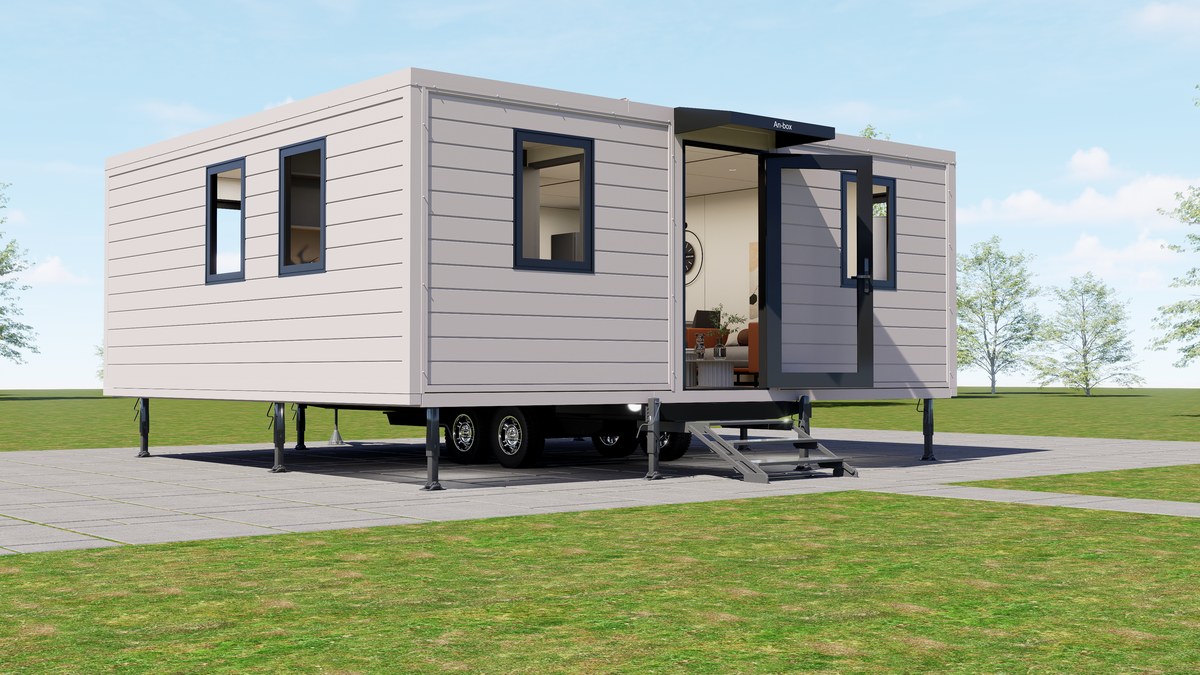
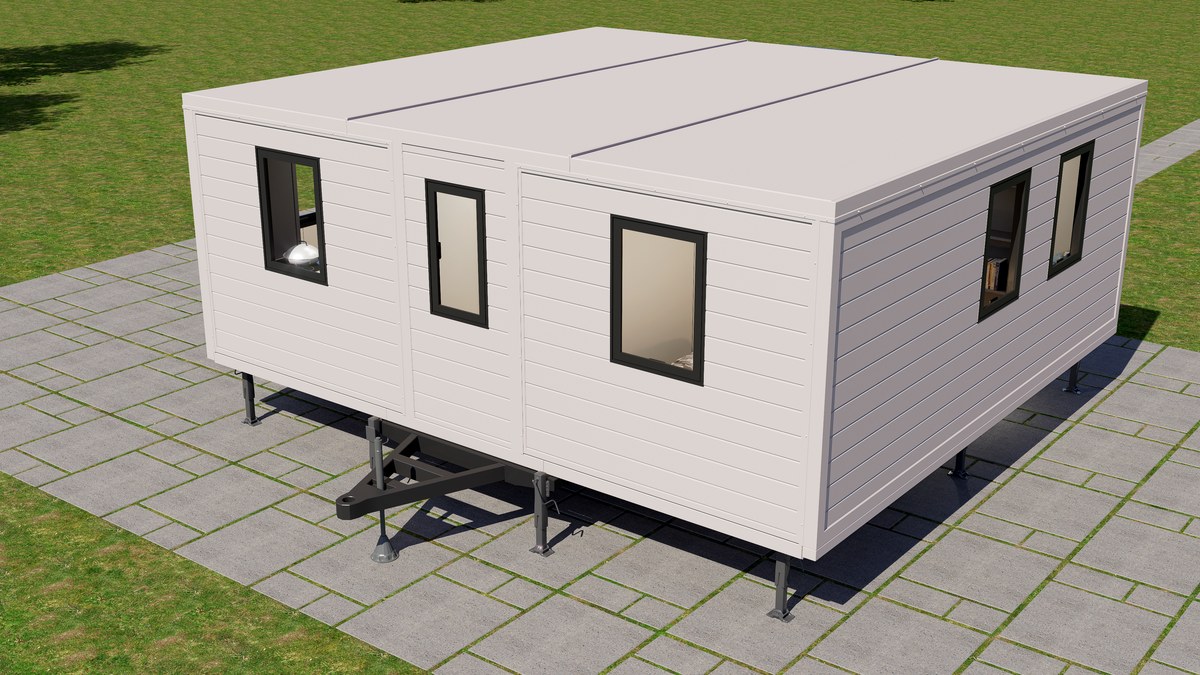
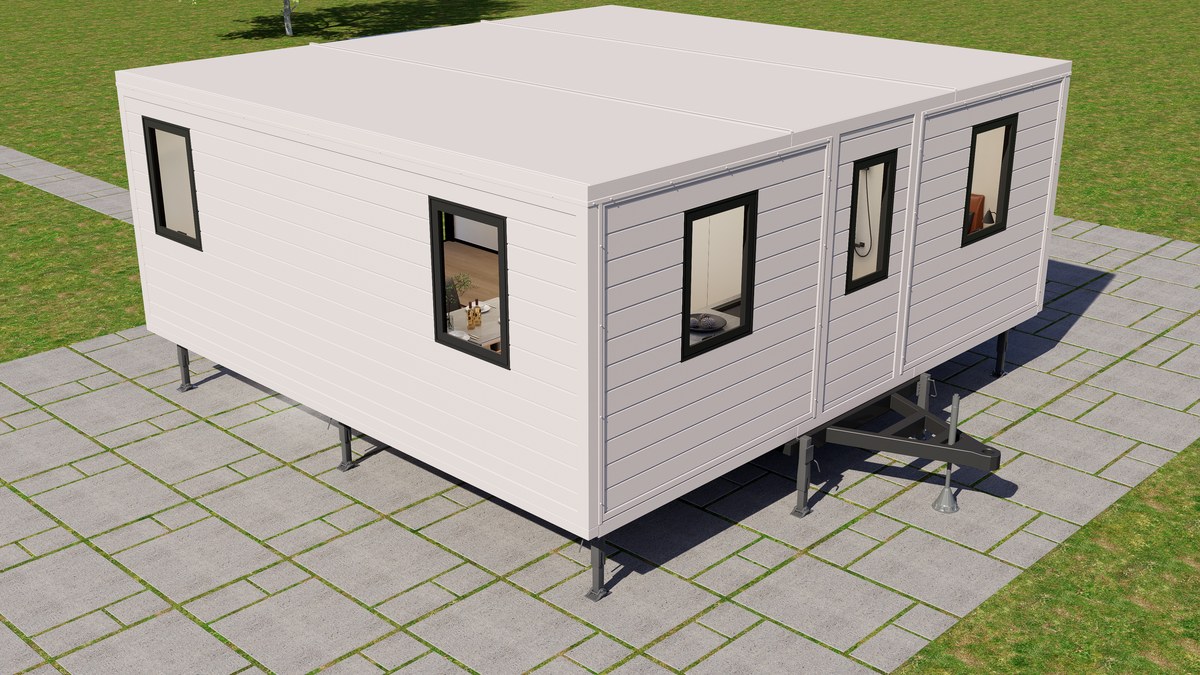
Some images are scheme illustrations and renders showing structure and layout. Final delivery follows the contract drawings.
What customers ask most
What tows it?
A 3,500 kg braked trailer needs a vehicle rated for it — a large pickup or a light truck. It has a 50 mm ball or a ring hitch, and it tows as a trailer with its own brakes and lights.
How long to set up?
Thirty minutes with two people: jacks down, level, wings out, bars locked, services connected. The first time on a new site takes longer because of the levelling.
Does it need a crane ever?
No. That is the point of the product. If you have a crane and the unit does not move, buy the static one — you will get more floor for the same money.
Is it road legal in my country?
The chassis is built to EU trailer braking and lighting standards. National type approval differs and is the importer’s responsibility; we supply the chassis drawing and the brake certificate.
Can it run off-grid?
Yes, with a generator bay, a water tank and a solar array on the roof. A clinic typically runs on 6 kW of array, 15 kWh of battery and a 500 litre tank.
Ask for a layout for your site
Send the site, the headcount, the ground conditions and the climate. You get a floor plan, a fold sequence and a price, at no charge, revised until it works.