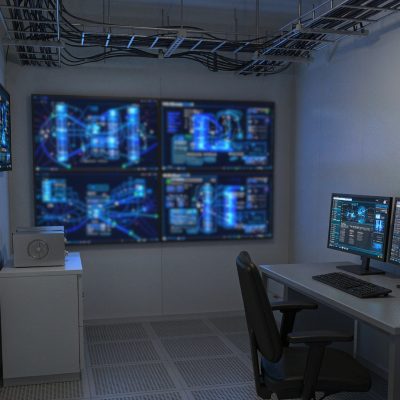


What it is for
Electricity is the one thing a data centre cannot lose. Servers can be clocked down, workloads can migrate, but a power cut takes everything.
The power module handles three jobs: absorbing utility instability with the UPS, transferring between two incoming supplies with the ATS, and distributing to each rack.
Putting the three in one enclosure shortens the wiring, cuts losses and simplifies servicing. The downside is concentrated heat. A 400 kVA UPS at full load loses more than ten kilowatts, all of it as heat, and it has to go somewhere.
So the power module normally does not share cooling with the IT module. It gets a small dedicated unit, or ducted extract to outside.
Where it is typically used
Key specifications
| UPS capacity | 200 / 400 / 600 / 800 kVA, modular N+1 |
| UPS type | Double-conversion online, IGBT rectifier |
| Efficiency | 96% double conversion, 99% in ECO |
| Input | 380/400 V three-phase four-wire, THDi below 3% |
| Output | 380/400 V, voltage regulation ±1% |
| Transfer | ATS with 1–10 s adjustable transfer time |
| Distribution | Incoming, metering, outgoing and rack panels |
| Outgoing circuits | 12–36, configured to rack count |
| Protection | IP54, internal temperature control and extract |
| Monitoring | Per-circuit current, power and energy over Modbus TCP or SNMP |
Figures are for the standard configuration and change with the project. Values are design values; acceptance follows the contract technical agreement.
What goes in the box
Installed, wired and tested before dispatch. On site the work is placement and external connections.
Modular power units, N+1, each module hot-swappable.
DC bus to an external battery module, with fuses and a DC breaker.
Two-supply changeover, mechanically interlocked against paralleling.
Incoming, metering, outgoing and bus-tie, copper rated to 800 A.
One circuit per rack with individual metering, A and B outputs.
Local touch screen, Modbus and SNMP to the monitoring system.
Which model to take
| Model | UPS rating | Active power | Outgoing circuits | Supply |
|---|---|---|---|---|
| AIDC-PWR200 | 200 kVA | 200 kW | 12 | Single |
| AIDC-PWR400 | 400 kVA | 350 kW | 24 | Single / dual |
| AIDC-PWR800 | 800 kVA | 700 kW | 36 | Dual 2N |
Standard models are listed. Other capacities are built to order, with two to three weeks added to the standard lead time.
Double conversion or ECO: is the 3% worth having
What the two modes do
Double conversion (online): utility power is rectified to DC and inverted back to AC. The DC bus in between blocks voltage sag, frequency deviation, harmonics and surges from reaching the load. The price is two conversion stages, each losing a little, giving about 96% overall.
ECO mode: in normal operation the load runs on the bypass, and the inverter idles on standby. When the supply goes out of tolerance the load transfers to the inverter in 2–4 ms. Efficiency reaches 99%, because only the bypass switch and filter are in the path.
The three points between them, on a 400 kVA UPS at 70% load, is 8.4 kW. Over 8760 hours that is 74,000 kWh. At 0.10 USD per kWh, about 7,400 USD a year.
What the saving costs
In ECO the load sees the raw utility supply. Voltage sags, lightning surges and frequency swings land directly on the server power supplies. Those supplies tolerate some of it, not all of it.
The transfer itself is the sharper problem. Two to four milliseconds is fine for most server supplies, which hold up for 10–20 ms. But if the load includes legacy equipment, industrial PCs or non-standard supplies, some of it will reboot.
The industry convention: where servers dominate and supply quality is good, ECO is defensible. Where there is industrial equipment, medical equipment or old kit, use double conversion and accept the loss.
And one more: many grids are simply not clean enough for ECO. Where voltage deviation exceeds ±10% or harmonic distortion is out of limits, ECO passes all of it to the load, and the electricity saved does not cover the equipment it damages.
The transfer chain
Utility fails, UPS takes over: 0 ms, since double conversion was already supplying the load.
UPS carries the load while the ATS sees the loss and transfers to the generator side: 1–10 s, adjustable.
Generator starts, builds voltage, closes: 10–15 s, with most standards requiring 15 s and good sets achieving 8–10.
The three stages add up to 25 s worst case. That is why autonomy is not set at five minutes. Fifteen minutes allows for a failed start and a second attempt.
When to use it, when not to
These come from projects rather than general advice. Match your case against them; it is more useful than reading the specification table.
UPS and distribution in their own enclosure, so servicing does not disturb the IT module.
The fixed cost of a dedicated enclosure is high. A UPS inside the IT module is better value.
Buy the power module alone and connect busbar and DC cable.
A fully loaded UPS loses over ten kilowatts. Internal temperature will pass 45 °C, so add cooling or forced extract.
From contract to energisation
Capacity, circuit count, 2N or not, ATS type.
Single-line diagram, panel layout, entry and exit positions.
Panel assembly, copper fabrication, wiring, dielectric test.
Full-load temperature rise, transfer test, protection settings.
Placement, busbar and battery connection, on-load commissioning.
On site and in detail
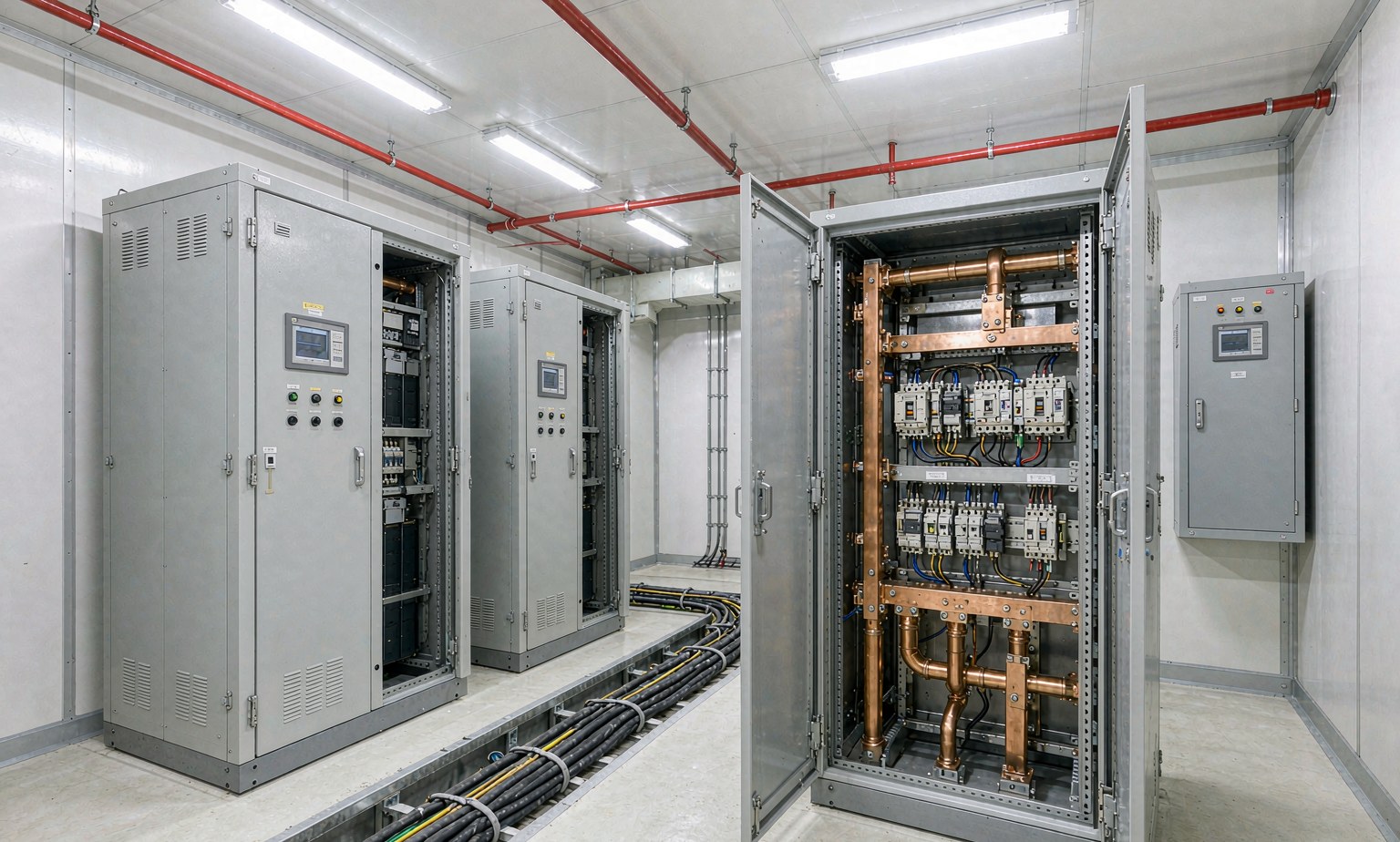
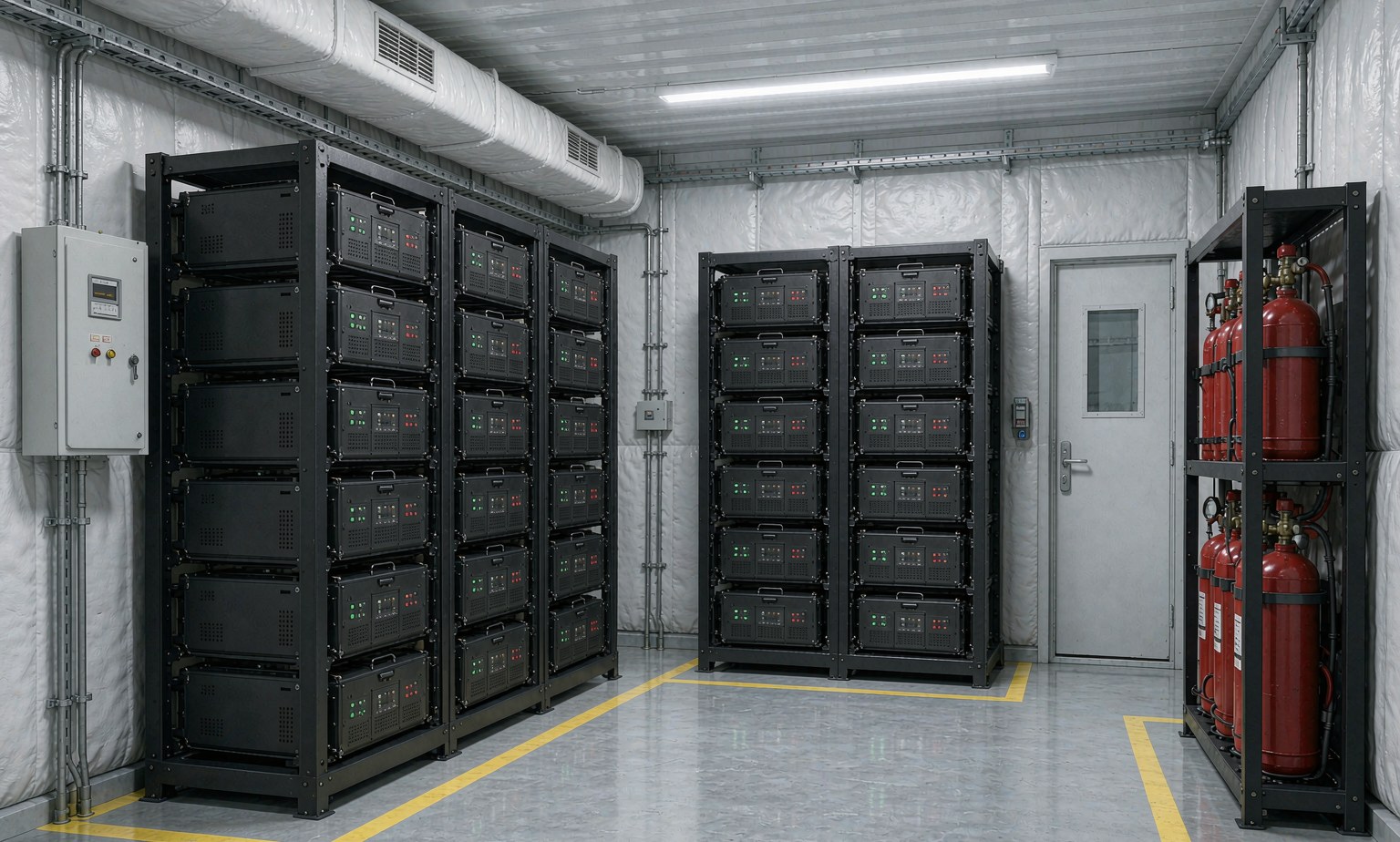
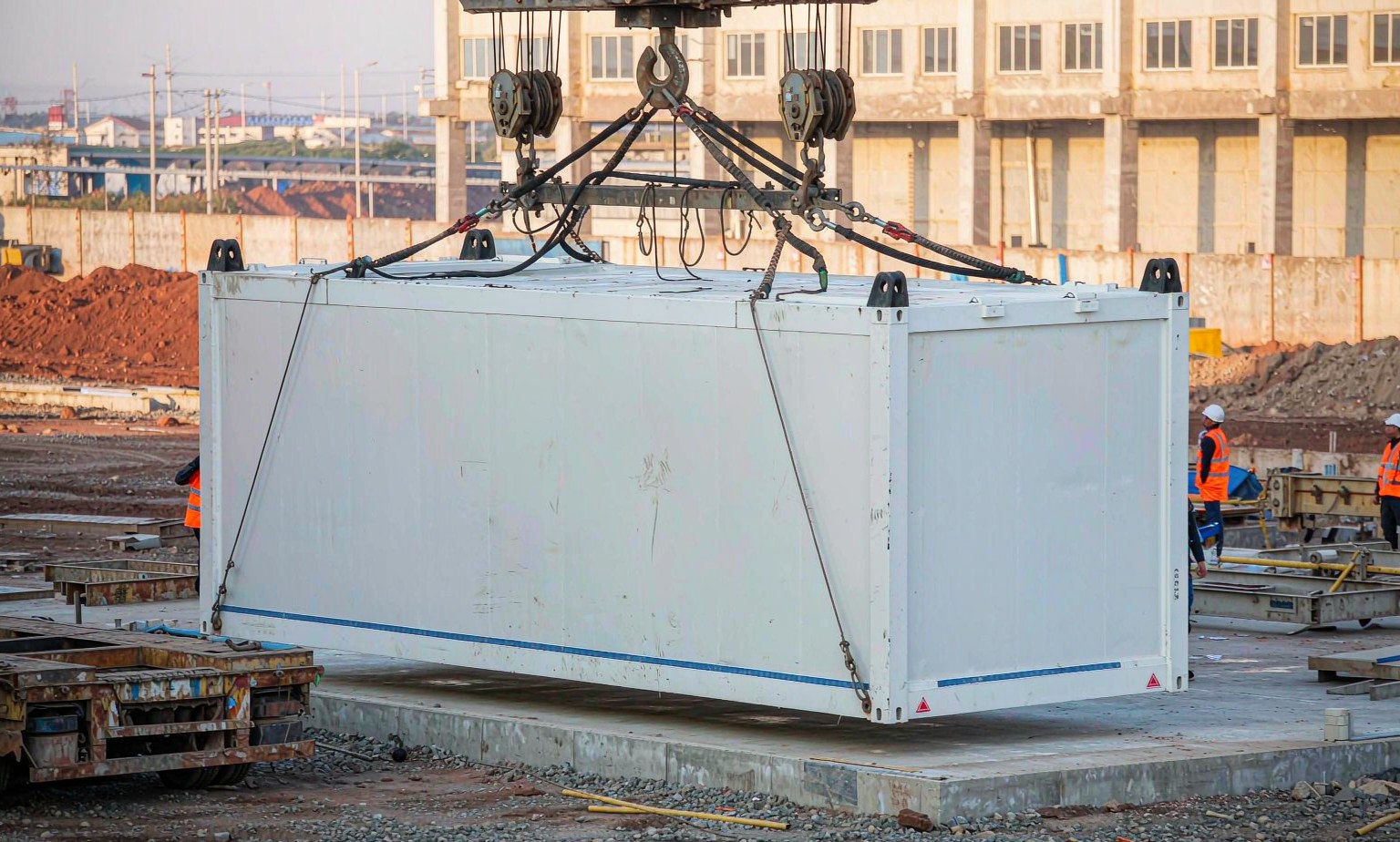
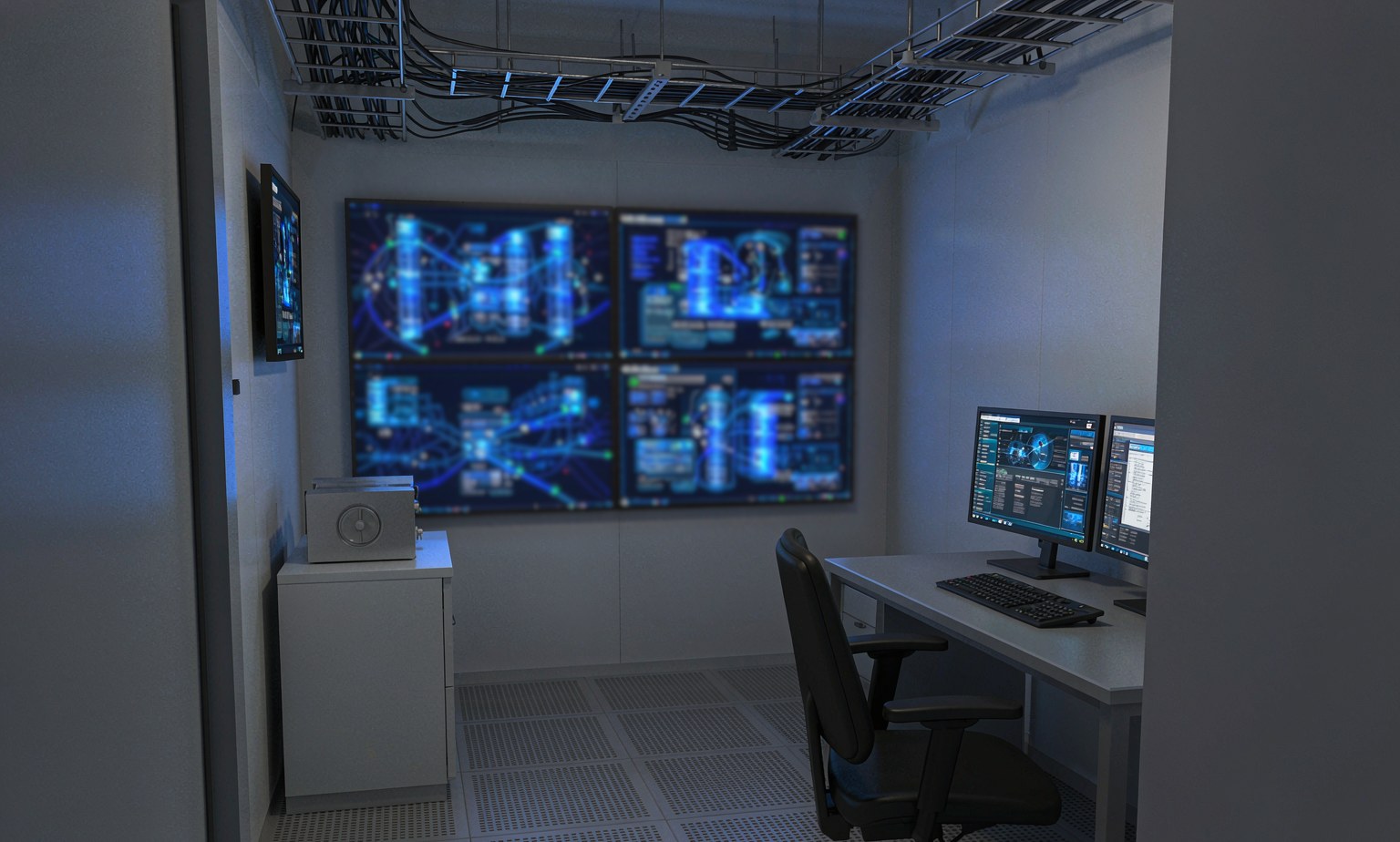
Some images are scheme illustrations and renders showing structure and layout. Final delivery follows the contract drawings.
What customers ask most
Does the UPS have to be modular?
We recommend it. Modules can be added as load grows, and a failed module is swapped hot without stopping the UPS. Transformer-based monobloc units are cheaper but need a shutdown to repair, which is why they are rarely specified now.
What is the difference between ATS and STS?
An ATS is a mechanical switch with a 1–10 s transfer, used between utility and generator. An STS is static, transferring in 4–8 ms, used between two utility sources. Where no interruption is acceptable, use an STS and pay for it.
What if there are not enough outgoing circuits?
Add rack panels. The main enclosure goes to 36 circuits; beyond that add a panel enclosure, or distribute at the IT module.
Must batteries be in a separate enclosure?
Above 200 kWh, yes. Lithium has high energy density, and next to switchgear a fire is much harder to fight.
Can it be installed outdoors?
It is an outdoor product at IP54. Watch internal temperature: in summer sun the enclosure reaches 55 °C and the UPS derates. Add a sunshade or forced ventilation.
Ask for a scheme for your site
Send the capacity, rack count, site conditions and local climate. You get a layout, a single-line diagram and a price, at no charge, revised until it works.