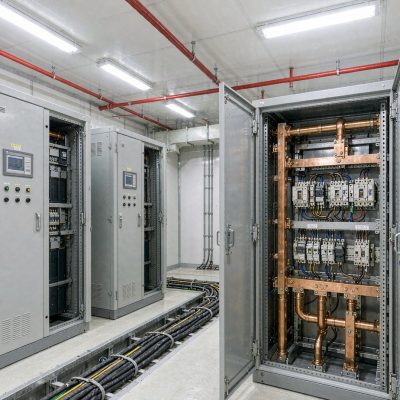


What it is for
A UPS buys minutes. For a long outage the generator is the answer.
Data centre generators have three characteristics: large (often matching the transformer), fast (on load inside 15 seconds) and idle (tested a few times a year).
Those three shape the design. Large means paralleling. Fast means acoustic enclosure and pre-heating. Idle means maintenance matters more than the machine, because diesel degrades in storage and starting batteries go flat. That is what actually causes most generator failures.
The containerised approach puts the set, day tank, control panel, silencer and exhaust inside a 20 or 40 ft enclosure. On site you provide a foundation, earthing and a cable.
Where it is typically used
Key specifications
| Rating | 500 / 800 / 1000 / 1600 / 2000 kVA |
| Voltage | 400 V / 10.5 kV for high-voltage sets |
| Starting | Electric, with 24 V starting battery and float charger |
| Start time | 10–15 s to full load including voltage build and closing |
| Paralleling | Up to 8 sets, load shared within 5% |
| Fuel | 8 hours standard, extendable to 24 or 48 |
| Noise | 75–85 dB(A) at 1 m, 70 dB(A) for the acoustic version |
| Emissions | China Stage III/IV; EU Stage V or US Tier 4F for export |
| Protection | IP54, weatherproof, ventilated for heat rejection |
| Ambient | −25 °C to +50 °C, jacket heater for cold regions |
Figures are for the standard configuration and change with the project. Values are design values; acceptance follows the contract technical agreement.
What goes in the box
Installed, wired and tested before dispatch. On site the work is placement and external connections.
Six or twelve cylinder, with jacket heater and fuel pre-heater in cold regions.
Brushless excitation, class H insulation, ±1% steady-state voltage deviation.
Auto start, paralleling, protection and remote communication with volt-free alarms.
Eight hours of fuel with level gauge, high and low alarms and overflow protection.
Bellows, silencer and rain cap, back pressure as specified by the set manufacturer.
50–100 mm acoustic lining, inlet and outlet baffles, access doors.
Independent detection in the fuel enclosure with dry powder or gas suppression.
Which model to take
| Model | Rating | Active power | Fuel | Noise | Enclosure |
|---|---|---|---|---|---|
| AIDC-GEN800 | 800 kVA | 640 kW | 8 h | 75 dB | 40 ft |
| AIDC-GEN1600 | 1600 kVA | 1280 kW | 8 h | 80 dB | 40 ft × 1 |
| AIDC-GEN2000 | 2000 kVA | 1600 kW | 8 h | 85 dB | 40 ft high cube |
Standard models are listed. Other capacities are built to order, with two to three weeks added to the standard lead time.
What the machine is doing during those fifteen seconds
Sequence
Second 0: utility fails, the UPS picks up the load and sends a start signal to the generator, by volt-free contact or over communications.
Seconds 1–3: the starter motor turns the crankshaft to 1500 rpm for a 50 Hz set, and oil pressure builds.
Seconds 3–8: voltage builds, the AVR brings it to rated value and frequency settles within 50 ± 0.5 Hz.
Seconds 8–10: the controller confirms voltage and frequency are in limits and closes the generator breaker.
Seconds 10–15: the ATS transfers from utility to generator, and the load moves across. Speed dips briefly on load acceptance and the governor pulls it back.
The whole sequence is required to finish within 15 seconds, and a good set achieves 8–10. Older sets, cold weather and air in the fuel line all make it slower.
Why a start fails
Three causes account for most failures, and none of them is machine quality.
The battery. A starting battery on permanent float loses capacity, and in cold weather it folds on the first crank. Test on load every quarter and measure capacity every six months.
The fuel. Diesel oxidises and forms gum after about six months in storage, blocking filters. Rotate the day tank monthly, and fit a polishing loop on sets that rarely run.
The pre-heater. Cold-region sets rely on a jacket heater to keep the block warm. A failed heater adds ten seconds or more, and sometimes means no start at all.
All three are maintenance issues rather than product issues. Which is why what you are really buying with a generator system is visibility: fuel level, coolant temperature, battery voltage, start count and fault codes, remotely.
Why paralleling matters
A single 2000 kVA set is already a large machine, constrained by transport and lifting. Beyond that you parallel.
Paralleling is not simply adding outputs. Two sets running together need synchronisation of phase, frequency and voltage, load sharing with kW by capacity and kVAR by excitation, and a plan for transferring load when one trips.
Under N+1, one set tripping means the others absorb the load instantly, speed dips and frequency falls, and the UPS on the load side has to ride through it. Dynamic response therefore matters more than steady-state specification.
One more point: keep the paralleling panel the same brand as the sets. Mixed brands argue about synchronisation logic, and commissioning takes far longer.
When to use it, when not to
These come from projects rather than general advice. Match your case against them; it is more useful than reading the specification table.
A generator is the only option; a UPS cannot cover it.
More battery is cheaper. Generator fixed costs, foundations, tanks, acoustic treatment and fire, are high.
Specify a high-altitude set with power derating, roughly 3% per 300 m above site altitude. A standard set smokes and under-delivers.
Noise and exhaust will not pass environmental review. Consider gas generation or a different site.
From contract to energisation
Rating, number of sets, fuel duration, emissions standard.
Foundation, fuel path, exhaust, cabling, acoustics.
Set integration, enclosure, acoustic treatment, controls.
Load bank test, paralleling, protection operation.
Placement, fuel and exhaust connection, cabling, load test.
On site and in detail
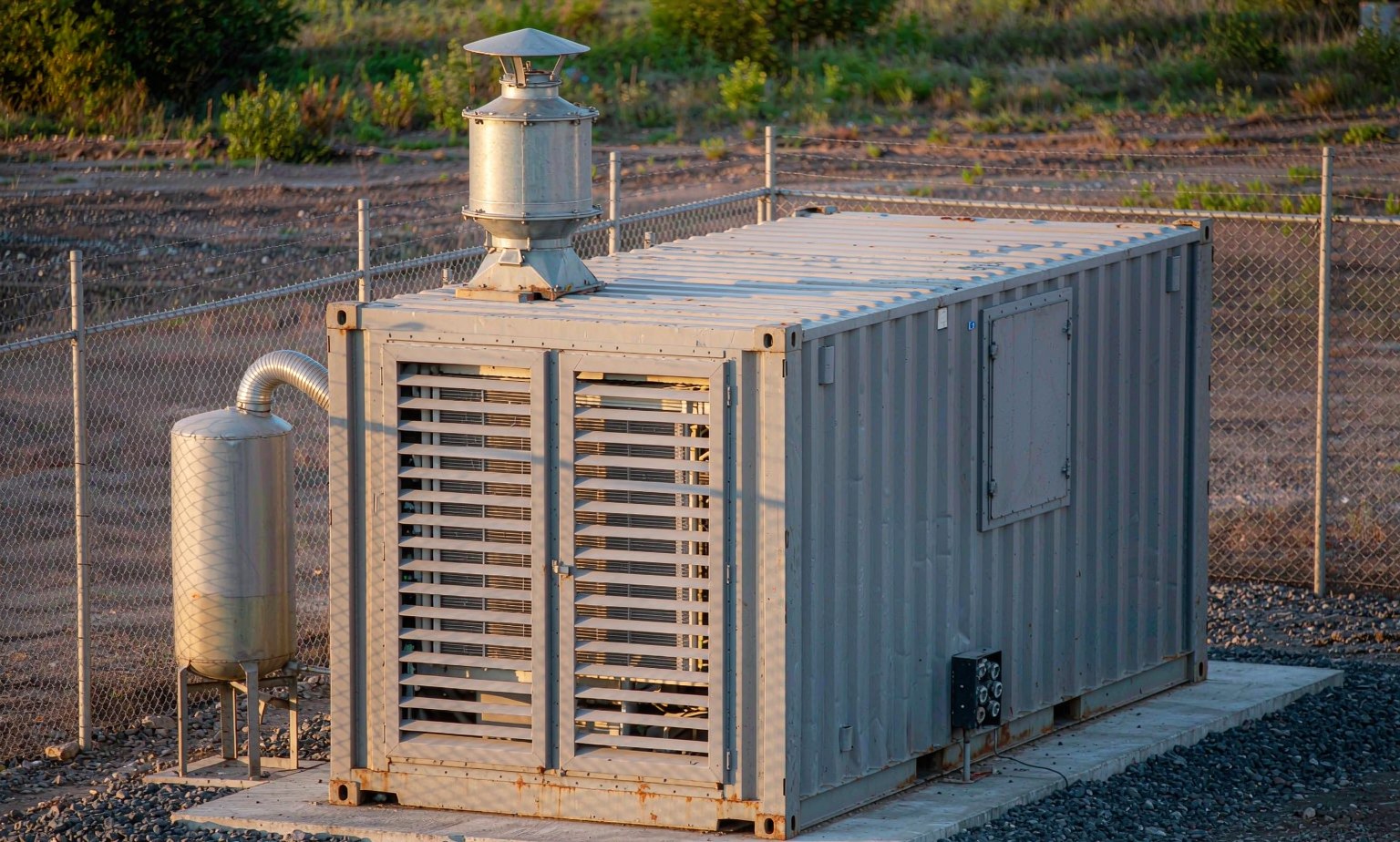
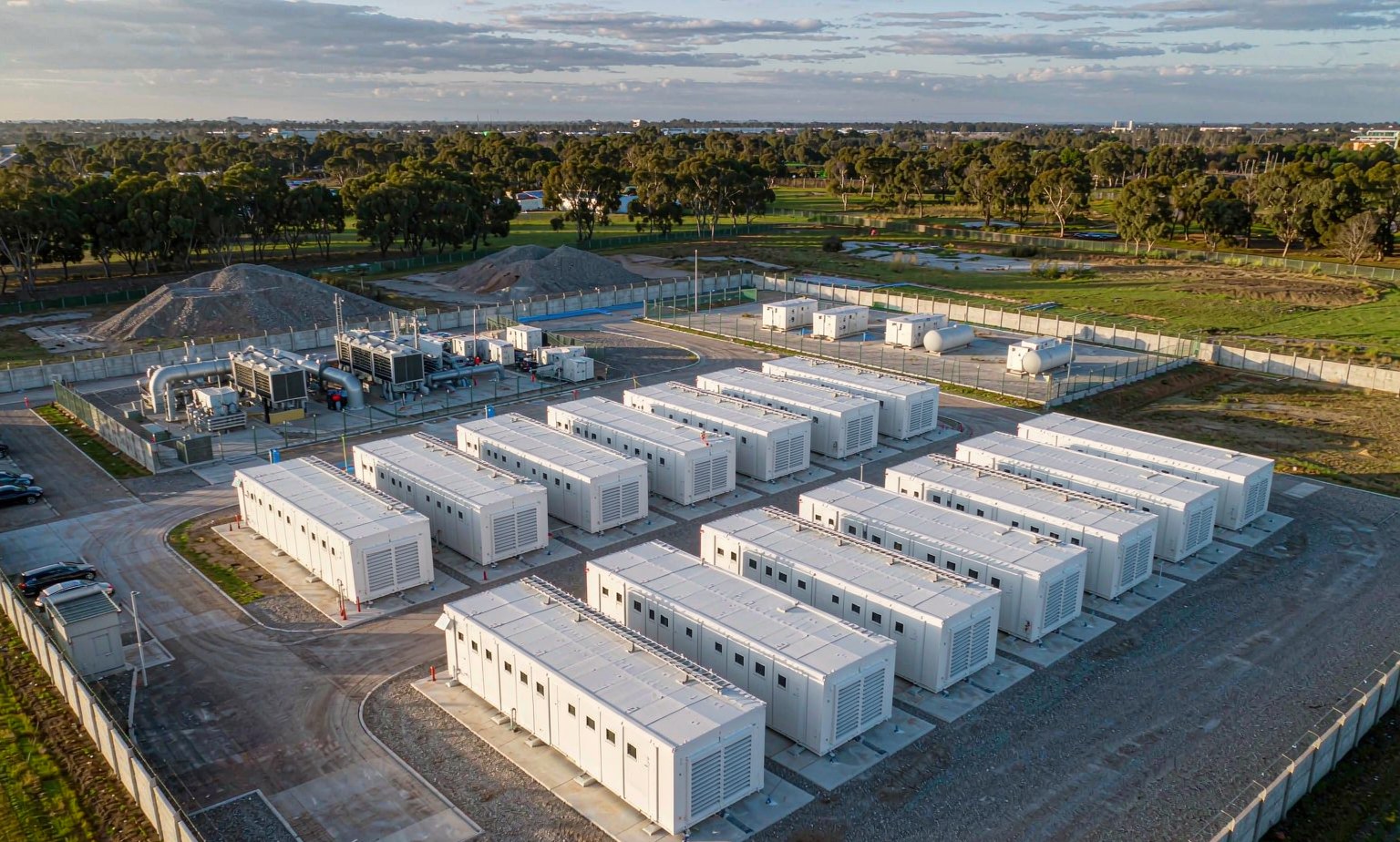
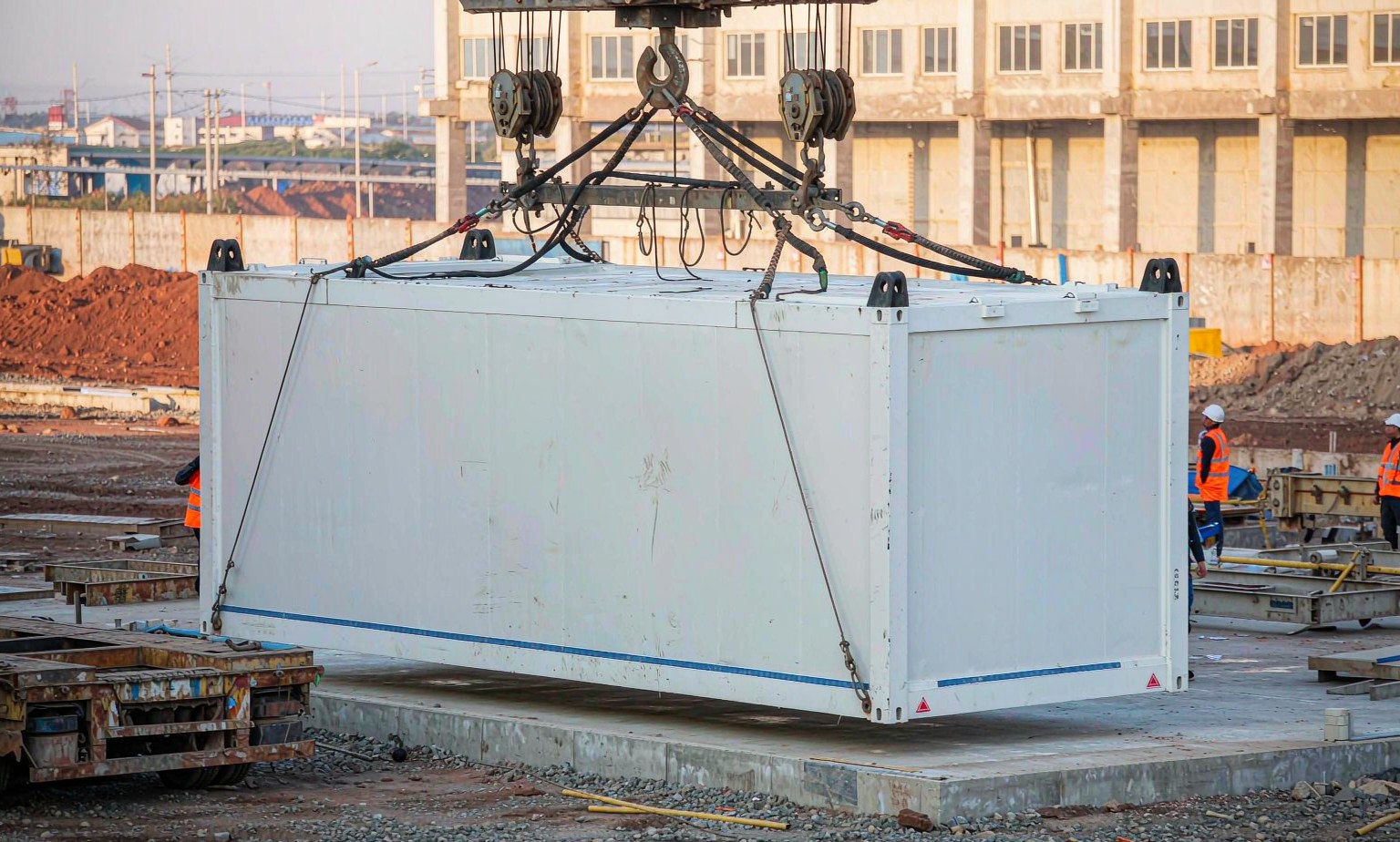
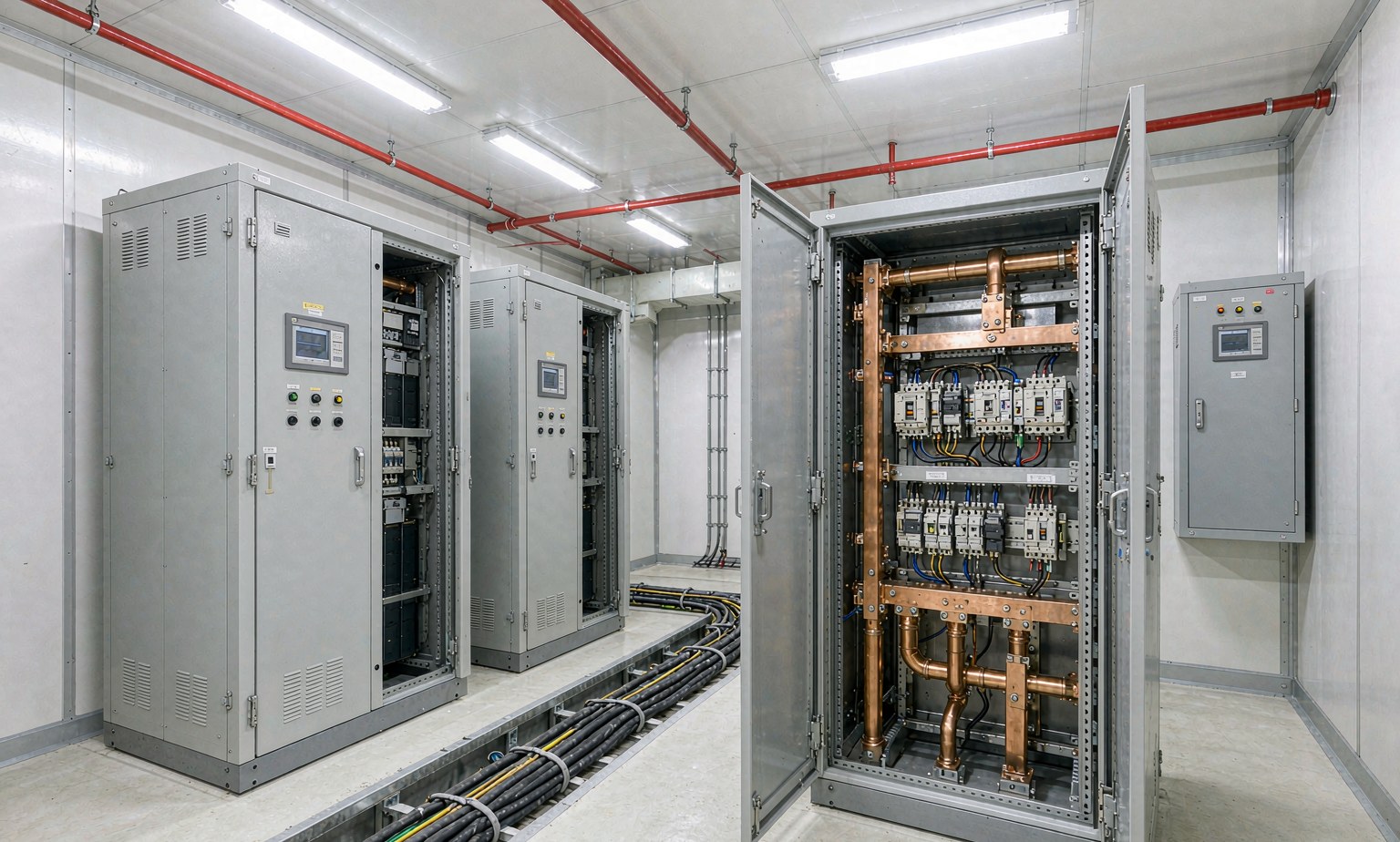
Some images are scheme illustrations and renders showing structure and layout. Final delivery follows the contract drawings.
What customers ask most
Is eight hours of fuel mandatory?
Eight hours is standard. Hospitals and financial institutions are often required to hold 24–48 hours. More fuel means bigger tanks and stricter fire requirements, and the price moves accordingly.
Does diesel go off in storage?
Yes. Ordinary diesel begins to oxidise after about six months. Rotate it monthly, add a stabiliser, or fit a fuel-water separator.
Can it run on gas?
Yes. Gas sets are cleaner and quieter, but need a pipeline or an LNG tank, which usually only makes sense at campus scale.
How is noise controlled?
Three layers: acoustic enclosure, silencer and a barrier wall. 70 dB(A) at one metre is the acoustic version; below 55 dB needs a dedicated plant room.
How many sets can be paralleled?
Eight in normal practice; beyond that you sectionalise the busbar. The more sets, the harder synchronisation and load sharing become, and commissioning time multiplies.
Ask for a scheme for your site
Send the capacity, rack count, site conditions and local climate. You get a layout, a single-line diagram and a price, at no charge, revised until it works.