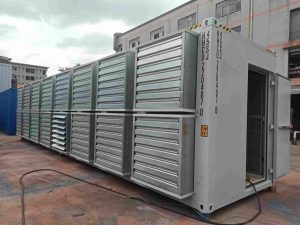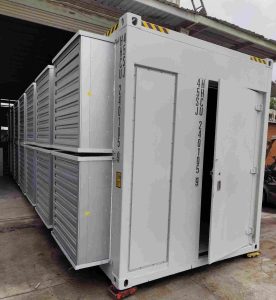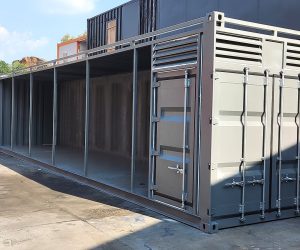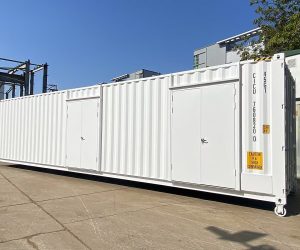
A mining-container request can look finished when it says “40HC, 336 miners.” In a real procurement review, that line opens several questions. Which miner is being counted? What is its actual load? Does the site receive 480 V at 60 Hz or 400 V at 50 Hz? Which PDU sockets are needed? Where will a technician stand when a filter or power module has to be changed?
ACTBOXES describes mining boxes and data-center containers, but the product name alone does not define a purchase-ready electrical package. Begin with the featured Container Data Center product as a reference, and ask for a quotation tied to the intended miner model, site utility and destination market.
Start with a miner schedule, not a container length
The buyer-supplied comparison material lists one standard 20GP entry with 162 positions and 691 kW operating load. It also lists North American 40HC entries with 336 miners and loads around 1382–1400 kW. The public ACTBOXES product page confirms a 336-miner configuration, but does not independently establish the full comparison-sheet load matrix. Keep these numbers attached to their precise variants.
Consider a planning sheet with 168 miners at 3.84 kW per position. The equipment load alone is about 645 kW, before fans, controls, network equipment and other auxiliaries. The 20GP row is short on positions. A 40HC row may have room, but its listed safe operating load still needs to be reconciled with the actual electrical schedule.
That arithmetic should change the first supplier conversation. Instead of buying a box solely because its label says 336 miners, check what the quoted operating-load figure includes, the auxiliary demand and which machine model owns the 3.84 kW assumption. A change of ASIC model after quotation can change both the electrical schedule and the cooling calculation.
Put the miner model, quantity, per-position load, target operating load and expected expansion margin at the top of the RFQ. A device count without those fields leaves the supplier to fill in the most important assumptions.
Match the power cabinet to the utility
The source material shows different main-control ratings, including 1200 A and 1250 A arrangements, while an upgraded entry lists 2500 A and 28 × 125 A branches. The publicly described ACTBOXES data center configuration uses a 1200 A main cabinet breaker and 80 A PDU protection. These figures belong to specific designs, not an automatic upgrade ladder. The supplier should identify the actual input feeds and protection schedule for the quoted model.
The product page describes 480 V / 60 Hz and 400 V / 50 Hz as available market configurations. A phase-by-phase utility review matters as much as the miner count. For reference, a single 1200 A, 480 V three-phase input corresponds to roughly 1.00 MVA of apparent power before derating. A claimed operating load above that level cannot be validated from one breaker number alone; request a single-line diagram showing how the total load is supplied.
The technical reply should include the single-line diagram, breaker ratings, grounding method and protection devices. The source mentions arc-fault protection, grounding tests and optional grid-interface fields. The buyer still needs to know which item belongs to the quoted model and where its evidence is recorded.
Use PDU design to test the maintenance plan
PDU design affects shutdowns and maintenance. ACTBOXES describes individually controlled drawer-style modules, with a published example of 14 miners per module. Its product page also describes hot-swap capability. Before relying on replacement while energized, the operator should obtain the model-specific isolation procedure, approved service method and spare-module details.
For a planning sheet with 168 miners, 14 positions per module suggests 12 groups before spares and the final wiring layout are considered. That number starts a practical discussion. Can one group be isolated while the other groups keep running? Where does the replacement module sit? Can a technician reach it without moving equipment?
The cabinet drawing should show cable bend radius, door swing and the service aisle. A rendered exterior cannot answer those questions. A spare module reachable from the correct side produces a different operating plan from one that requires equipment removal.
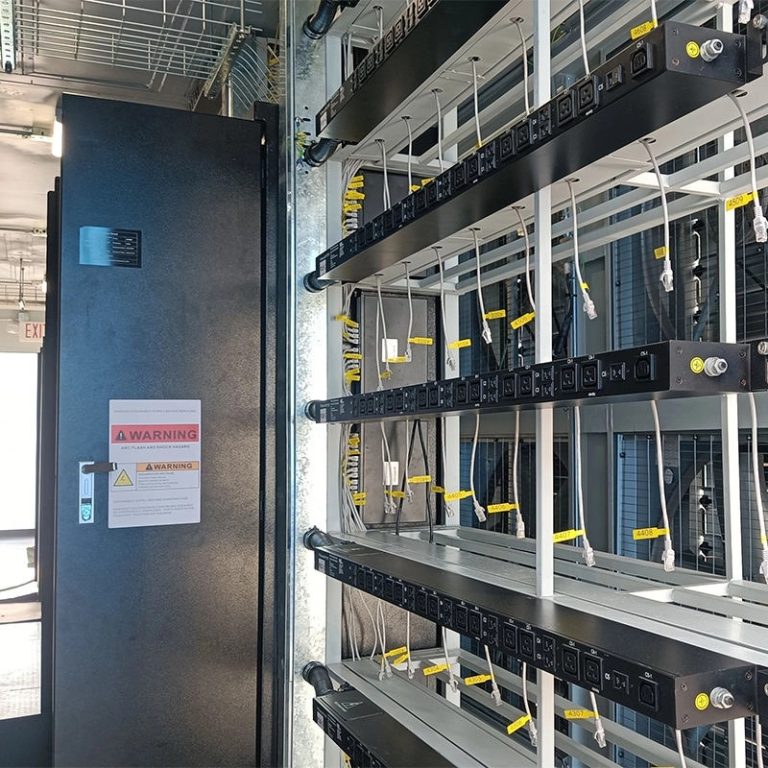
ALT: ACTBOXES mining container PDU racks with multiple power outlets and cable connections
Make cooling a site decision
The product material mentions low-temperature preheating, high-temperature exhaust compensation and an IP54 field. Other comparison entries discuss negative-pressure fans, evaporative pads, snow barriers, air hoods and filters. Those are not automatically the specification of every product in the range; the selected intake and exhaust design must be shown on the quotation.
Those options do not choose an intake system by themselves. A hot site with coarse dust creates a different cleaning routine from a cool, wet site. A seasonal farm may use a different fan and heater sequence from a box running at a steady load all year. The same container label can therefore lead to different maintenance work.
Put the expected temperature range, dust level, rain or snow exposure and preferred intake in the RFQ. Ask how an evaporative system is supplied, drained and maintained, and which filters are assumed in a coastal or dusty location. A listed environmental field does not establish a hash-rate, uptime or energy-saving result at a customer site.
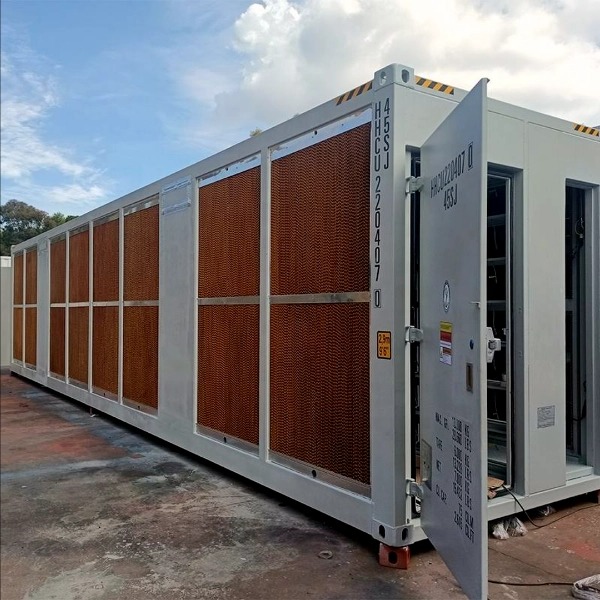
ALT: ACTBOXES data center container exterior with evaporative cooling pads along the air-intake side
Check the shell against the route and the service side
ACTBOXES describes galvanized steel plate, insulated panels, a welded frame and a marine-container structure for its data-center product. Its published product sheet also refers to a 20-ton body load-bearing figure. Confirm the actual equipment weight, transport weight and structural scope for the model being offered.
The quotation needs the selected construction, external dimensions, total weight, lifting points, access doors, corrosion treatment and support points. Draw the route beside those details. A transportable container can still fail a local gate, turning movement or crane plan.
The service side belongs on the site plan as well. If the container sits close to a wall, a filter or cabinet door may exist on the drawing but remain unusable in practice. Place the maintenance clearance before the foundation is finalized.
Keep certificates tied to the assembly
ACTBOXES technical material contains UL/CSA component references and a full-box CSA-report claim for its featured data-center configuration. The buyer should not read those as proof that every standard, regional or upgraded variant has the same report.
A useful technical reply names the certificate number or test report, tested configuration and product version. It states whether the document covers the full container or one component. The authority having jurisdiction and local inspection route still need confirmation. Certification is evidence for an assembly; it is not a substitute for local project approval.
For context, ACTBOXES describes a Texas container-data-center installation; the case illustrates deployment experience, not approval of a particular imported electrical package.
Decide the control and network handoff
The product section describes Modbus RTU, RS485/Ethernet communication, SCADA docking and one-to-one network cable configurations. The project still needs to decide the controller, protocols, data points and network ports, together with who supplies the upstream switch, firewall and backhaul.
An operations team may want an alarm list covering temperature, fan status, breaker state, PDU current and communication failure. It should also know where event history is stored and who can access it after handover. Those decisions are easier to make before the container is wired.
Normalize the price before choosing a supplier
Send the miner model and count, measured power draw, voltage and frequency, climate, cooling and PDU preferences, network handoff, destination-market requirements and service clearances. ACTBOXES also explains how mining container prices vary by design and capacity.
Ask for separate prices for the shell, electrical cabinets and PDUs, ventilation, monitoring, testing and spares. Foundations, transformers, site cabling, network backhaul, crane work, drainage and commissioning should be inclusions or explicit exclusions; otherwise two headline totals may cover different scopes.
Send the miner and utility schedule through the ACTBOXES contact page. Ask for the exact version, arrangement drawing and exclusions; “336-miner container” alone does not establish operating capacity.
Conclusion
A Bitcoin mining container is an electrical, cooling and transport package. Confirm the miner schedule, PDU groups, airflow, access, certificate scope and grid interface against one selected product configuration before ordering.
FAQs
What should buyers send with the first RFQ?
Include the miner make and model, quantity, measured power draw, utility voltage/frequency, climate, preferred cooling, PDU sockets, network handoff and expected maintenance access.
Is the listed miner count the same as operating capacity?
No. Count is a physical layout figure. The design still needs acceptable continuous input power, breaker/PDU coordination and enough cooling for the selected machines.
Can a 336-miner configuration be used with any ASIC miner?
Not without checking. Miner dimensions, connectors, individual power consumption and airflow direction vary. Ask for a layout and electrical schedule tied to the exact ASIC model.
Do UL or CSA references complete local project approval?
No. Obtain the report for the actual assembly and check the installation and inspection requirements in the destination market.
Which costs may fall outside the container price?
Foundation, transformer or switchgear, external cables, network backhaul, crane work, drainage, commissioning and local inspection may be separate line items unless included explicitly.