In a procurement meeting, “20-foot data center container” is often treated as a complete request. It is only a starting label. The buyer may still need to choose between 20GP and 20HC, standard and North American electrical versions, and different equipment-position and load assumptions. A container that fits the road can still fail the utility review or leave the service side inaccessible.
The ACTBOXES comparison material lists 20GP, 20HC, 40GP and 40HC data center formats, including separate North American electrical versions. These are preliminary comparison figures, not a substitute for the selected model’s drawings. The public ACTBOXES product page describes a specific mining-container configuration rather than a complete size matrix.
Compare 20GP and 20HC before choosing a longer container
In the supplied comparison sheet, the standard 20GP is 6058 × 2438 × 2591 mm, with 162 equipment positions and a listed operating load of 691 kW. A 20HC keeps the same length and width, rises to 2896 mm and lists 189 positions: 27 extra positions with an additional 305 mm of external height. The sheet gives both standard 20-foot entries the same 691 kW load. More equipment locations do not automatically mean more usable electrical capacity.
|
Format |
External dimensions (mm) |
Positions |
Listed operating load |
|---|---|---|---|
|
20GP |
6058 × 2438 × 2591 |
162 |
691 kW |
|
20HC |
6058 × 2438 × 2896 |
189 |
691 kW |
|
40GP |
12192 × 2438 × 2591 |
324 |
1382 kW |
|
40HC |
12192 × 2438 × 2896 |
378 |
1382 kW |
Comparison-sheet values only; the selected market version and electrical rating must be reconfirmed in the supplier quotation.
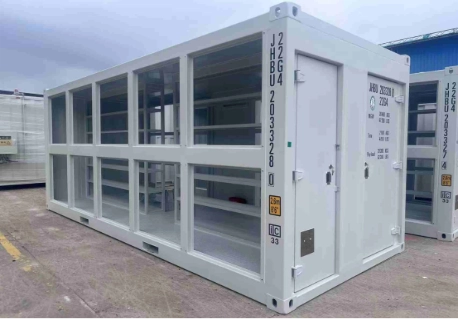
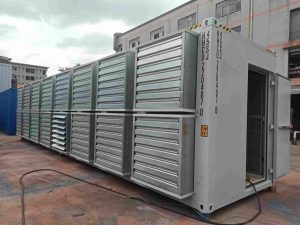
ALT: ACTBOXES 20GP mining container exterior with visible equipment-frame openings
Suppose a planning list contains 170 machines. The 20GP row is short on positions; the 20HC row stays on the shortlist. The 20HC row does not prove that the 170 machines can run at the desired load. The buyer still has to match per-position load, cabinet arrangement, cooling demand and site utility. The position count is one filter, not the whole decision.
The North American rows in that sheet list 144 positions for 20GP and 168 for 20HC, rather than 162 and 189. The public ACTBOXES Container Data Center page also describes a 336-miner configuration; that public claim is not the same as the standard 40HC row listing 378 positions. Keep the region, socket/PDU layout and model code beside every capacity figure.
What changes when the project moves to 40 feet?
The comparison sheet puts the standard 40GP at 12192 × 2438 × 2591 mm, with 324 positions and 1382 kW listed operating load. Its 40HC entry has the same length and width, a height of 2896 mm and 378 positions. That 54-position increase may change the layout shortlist, but the table lists the same 1382 kW load for both formats. Ask for the exact model drawing and electrical schedule before treating those values as firm project capacity.
A hypothetical schedule of 350 positions keeps 40HC in the discussion. A schedule of 250 high-load machines may point toward a different version even though 40GP has enough listed locations. I would compare the load and the route before I compare the number of boxes. The larger format can reduce interconnections, but it also changes the gate, turning movement, lifting, foundation and maintenance side.
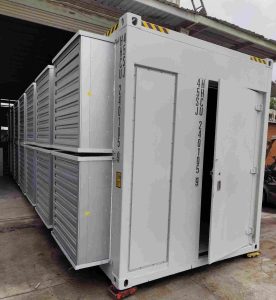
The site drawing should show the electrical-cabinet side and the filter or fan access. A shell may fit the foundation while the people who service it cannot reach the equipment. That is a placement problem, not a catalogue problem.
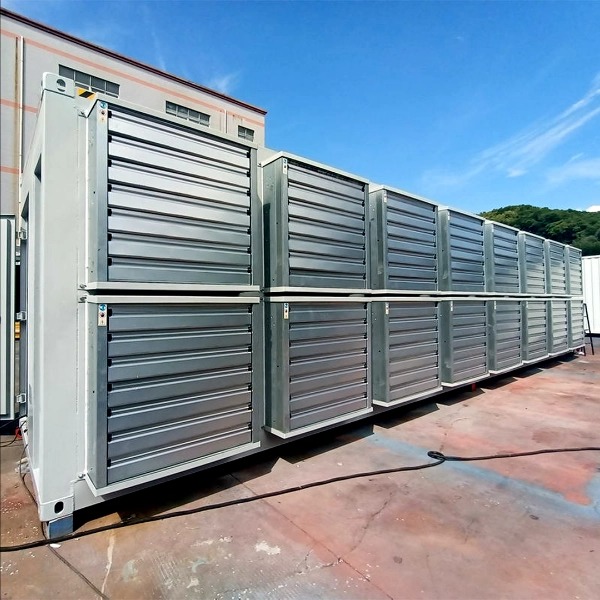
ALT: ACTBOXES data center container exterior showing its fan-side ventilation equipment
Do not mistake position count for electrical capacity
A supplier can use a position load, connected load and safe operating load in the same quotation. Those numbers answer different questions. The buyer needs to know what each one includes.
For a quick check, 324 positions at 3.84 kW each produce about 1,244 kW before fans, controls, networking and other auxiliaries. That arithmetic does not approve the design. It explains why a source-listed safe operating load of 1382 kW cannot be read as “324 machines at any load.” The electrical schedule should show the assumptions behind the figure.
The comparison material lists 1250 A main-control and 14 × 80 A branch-control figures for some versions, while an upgraded 40HC entry lists 2500 A main control and 28 × 125 A branches. The public product page refers to a 1200 A main breaker for a particular 336-miner configuration. They are not interchangeable specifications. As a rough electrical cross-check, 1250 A at 480 V three-phase corresponds to about 1.04 MVA of apparent power before power-factor and continuous-load considerations. A quotation pairing that incoming arrangement with a listed 1382 kW operating load needs an explanation of feeds and electrical architecture; the figures alone cannot establish compatibility.
Cooling is a site assumption
The product material describes variable-speed negative-pressure fans and two intake options: evaporative cooling pads with dust filtration for some hot sites, and an air hood with a dust filter for wetter or snowy locations. These are options from the source material, not verified standard equipment on every listed size.
Those options cannot be selected from the title alone. A hot, dusty site may need a different filter and cleaning routine from a cool, wet site. A box operated in batches may use a different fan sequence from a continuously loaded box. The RFQ should state the assumed temperature, airflow, filter access and alarm points so the supplier is answering the same question.
The service side matters here. If a fan or filter requires equipment removal, the maintenance procedure and downtime change. I would ask for the fan layout, filter path and the clearance around the electrical cabinet rather than leaving that decision to installation day.
Market version, service connections and certification
The comparison file lists network switches, individual equipment labels and cable configurations, but these details are better checked against the interior layout rather than assumed from the container length. For the broader range, see the ACTBOXES Bitcoin Zone category. The chosen drawing should identify the cable entry point, electrical cabinet, cooling access and the handoff to the site network.
Standard, North American and upgraded entries also show different sockets, electrical ratings and certification fields. For a North American project, request the CSA or UL evidence covering the quoted electrical assembly. For other markets, state the intended voltage, frequency and local code requirements rather than borrowing a North American specification.
ACTBOXES publishes a full-container CSA report claim for its featured data center product. That should still be checked against the report number, tested configuration and local approval requirements. A certificate for one arrangement is not automatic approval for another model or installation.
What to include when asking for a size-based quotation
The first RFQ should contain the equipment model, quantity, load per position, target operating load, box format, site location, ambient conditions, dust or rain exposure, utility data, socket preference, network handoff, cooling preference and maintenance clearance. The supplier response should include a dimension drawing, internal layout, electrical schedule and cooling/intake description.
ACTBOXES has also documented a container-data-center installation in Texas. That project illustrates modular deployment, but it does not certify the capacity or site fit of the model being priced.
The exclusions need the same discipline. Civil foundation, transformer work, external cabling, final grid connection, crane work and commissioning may sit outside the container package. If one bidder includes a transformer and another excludes it, their headline totals are not describing the same project.
For a useful technical reply, share the shortlist of container formats, machine schedule and access constraints through the ACTBOXES contact page. If the supplier proposes a different model, recheck the layout, listed positions and power plan rather than accepting a size label alone.
Conclusion
Start with the container envelope and equipment positions, then test the selected version against power input, cooling, access and service clearances. The ACTBOXES comparison sheet shows why 20GP versus 20HC and 40GP versus 40HC are different purchasing choices. Its numerical entries still need confirmation against the exact model and electrical drawing before final approval.
FAQs
Is a 40HC always the better option than 40GP?
No. A 40HC may offer extra positions through added height, but lifting clearance, power architecture, cooling and the service area can outweigh the extra space.
Why can the North American version hold a different number of machines?
The supplied sheet shows different position counts for regional versions. Socket layout, PDU arrangement and electrical requirements may change the interior; request the version-specific drawing.
Does a listed 1382 kW load guarantee 1382 kW at my site?
No. Confirm the incoming voltage, number of feeds, circuit protection, usable continuous load and auxiliary demand with the supplier’s electrical schedule.
Can a 20-foot data center container handle a list of 170 miners?
The supplied standard 20GP row lists 162 positions, while standard 20HC lists 189. Whether 170 units can actually operate depends on the selected market version, power per miner and cooling.
What if the supplier offers a substitute format?
Compare the new model code, outer dimensions, position count, power package and service access. Do not treat the same nominal length as equivalent.